
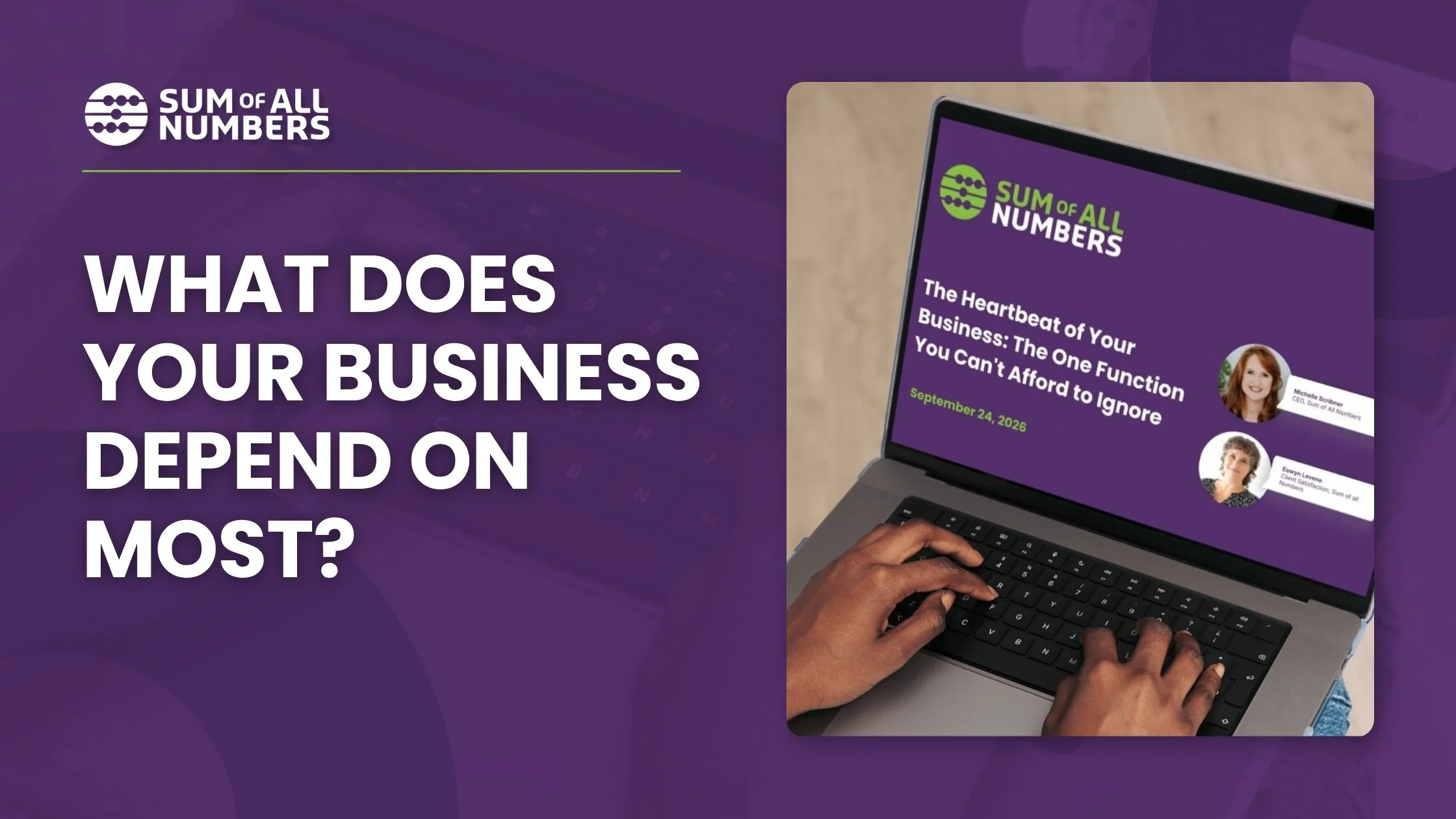
Expert workshop: What's the One Function Your Business Can't Survive Without?
What Is the Queen Bee Role in Business?
The Queen Bee Role is the one function, quality, or standard a business needs to protect because of its impact on the rest of the company. It isn't necessarily the owner, a specific employee, or even a department. It can be something like quality, communication, or integrity that needs to show up throughout the business.
A simple way to start identifying it is to ask:
What would happen if this function stopped?
Then consider how quickly the business would feel the impact and how significant that impact would be.
This matters because many business owners spend their time protecting what feels urgent instead of identifying what the business genuinely depends on. Once the critical function is clear, it becomes easier to decide what deserves your attention, what can be delegated, and what needs to be built into your systems and team.
Quick Answer: How Do You Find Your Queen Bee Role?
Map: Identify the functions and responsibilities happening across the business.
Run the test: Ask what would happen if each function stopped.
Validate: Compare your assumptions with real business situations and input from your team.
Protect: Build the function into hiring, training, procedures, delegation, and daily decisions.
Revisit it: Your Queen Bee Role can change as the business, team, customers, and technology change.
The goal isn't to find the task you enjoy most.
The goal is to identify what your business needs to protect most.
Why Does the Queen Bee Role Matter to a Business Owner?
The Queen Bee Role matters because it helps separate what you do from what the business actually needs from you.
When everything seems important, owners can stay involved in too many decisions. They may become the person everyone turns to when something goes wrong, even when someone else could handle the work.
That creates a business that depends heavily on the owner.
The Queen Bee Role gives you a different question to ask:
What actually needs to be protected, and what can someone else take responsibility for?
That distinction can change how you think about delegation, hiring, training, and your own time.
If the critical function isn't clear, you can spend a lot of energy keeping the business busy without necessarily protecting what keeps it working.
What Exactly Is a Queen Bee Role?
A Queen Bee Role is a critical function, quality, or standard that has a significant impact on the business and needs to be protected.
The concept comes from Mike Michalowicz's Clockwork, which uses the queen bee as an analogy for identifying the function around which the rest of the business operates.
The important distinction is that the Queen Bee Role is not automatically the owner.
It also doesn't have to be a single task.
A business might need to protect:
Quality
Communication
Integrity
Customer experience
Another function or standard that affects how the business operates
The role is defined by its impact, not by how enjoyable the work is.
How Do You Know If You're the Queen Bee?
You're not necessarily the Queen Bee.
In fact, one of the biggest misconceptions about this concept is that the owner must be the most important function because so much of the business currently runs through them.
But there's a difference between being involved in everything and being responsible for protecting what matters most.
If the owner is the only person who knows how to make every important decision, that's a sign to look deeper.
The question isn't:
"How do I prove that my business needs me?"
It's:
"What does my business need protected, even if I'm not the person doing the work?"
That shift is important because the goal is not to make yourself more indispensable.
It's to understand what the business depends on and build the people and systems around it.
Can the Queen Bee Role Be a Quality Instead of a Task?
Yes. A Queen Bee Role can be a quality or standard that appears across many different parts of a business.
Michelle shared an example from her family's real estate business that shows this clearly.
The company had been operating for 75 years. When Michelle was a teenager working in the office, she was once asked to redo a stapled packet because the papers weren't perfectly straight.
That might sound like a small office detail.
But the same standard appeared in much bigger business decisions.
The company created custom contracts rather than simply using standard forms. It used premium off-white paper. When it built an apartment complex, it chose granite countertops and custom cabinets.
The apartment complex eventually had an 800-person waitlist in a town of about 15,000 people.
The staple wasn't the critical function.
The paper wasn't the critical function.
The countertops weren't the critical function.
The underlying standard was quality.
Quality appeared in both the smallest details and the largest decisions.
That gave the business a consistent filter for how it operated.
This is one reason the Queen Bee Role can be more useful than simply listing your most important tasks. Sometimes the thing you're trying to protect sits underneath the tasks.
How Do You Find Your Queen Bee Role?
The process can be broken into four steps: Map, Run the Test, Validate, and Protect.
1. How Do You Map Your Business Functions?
Start by identifying the functions and responsibilities happening across the business.
Don't stop at broad categories such as "operations" or "customer service." Look at the actual work underneath those categories.
For example, "I handle customer complaints" could include listening, gathering information, deciding on a response, coordinating internally, and following up.
You want to see the work clearly before deciding which part matters most.
Action: Write down the functions and responsibilities you and your team are currently handling.
2. How Do You Run the "What If It Stopped?" Test?
For each function, ask what would happen if it stopped.
Use two questions:
| Question | What you're looking for |
|---|---|
| How quickly would the business feel it? | Immediate, soon, or over time |
| How significant would the impact be? | Minor disruption or serious consequence |
Some problems would become obvious immediately.
Others might take longer to appear but still have a meaningful effect on customers, quality, or the business.
The combination of speed and impact can help you identify which functions deserve the most attention.
Action: Take your list and ask what would happen if each function stopped tomorrow.
3. How Do You Validate Your Critical Function?
Don't rely only on your own assumption.
Validation means looking at what actually happens in the business. Talk with your team. Think through real situations. Look at what breaks down when an important function is disrupted.
You may discover that the function you initially thought was critical isn't actually the one the business depends on most.
The purpose of this step is to move from:
"I think this is important."
to:
"The business has evidence that this matters."
Action: Ask your team what they believe the business could not afford to lose and compare their answers with your own.
4. How Do You Protect the Queen Bee Role?
Once you've identified and validated the function, build it into the way the business operates.
That can include:
Hiring
Training
Standard operating procedures
Performance reviews
Delegation
Employee feedback
Recognition and praise
Day-to-day decisions
The goal isn't to keep the critical function dependent on the owner.
It's to make sure the people and systems throughout the business understand what needs to be protected.
Action: Look at one existing process, hiring decision, or team responsibility and ask whether it supports the function you've identified.
Can Your Queen Bee Role Change Over Time?
Yes. Your Queen Bee Role can change as your business evolves.
Sum of All Number’s own Queen Bee Role has changed over time. Michelle explained that it once centered more heavily on communication with clients. Today, it has evolved into individually caring about the people Sum of All Numbers works with and their businesses.
That shows up in practical decisions, including how information is presented and how communication is adapted to the person receiving it.
Technology can also change what a critical function looks like.
AI can now handle tasks such as categorizing transactions and generating communications. But automating a task doesn't automatically eliminate the function behind it.
The more useful question is:
What are you actually trying to protect?
A task may change.
The underlying reason that task matters may be much more important.
How Does the Queen Bee Role Help With Delegation?
The Queen Bee Role gives you a clearer filter for deciding what stays with you and what moves to the team.
Instead of asking:
"What can I get off my plate?"
Ask:
"What needs to stay connected to the function we're protecting?"
That changes delegation from simply getting rid of tasks to intentionally distributing responsibility.
Some work may still be necessary, but that doesn't mean it needs to stay with the owner.
When the critical function is clear, you can delegate around it rather than delegating blindly.
The goal isn't simply to do less.
It's to know what deserves your attention.
What Happens If You Never Identify Your Critical Function?
When the critical function isn't clear, the owner can remain involved in work that doesn't actually require their attention.
The team may also lack a clear filter for competing priorities.
Over time, that can contribute to:
More owner dependence
Unclear delegation
Inconsistent standards
Important functions receiving less attention
More time spent responding to whatever feels urgent
The problem isn't that every business needs to run perfectly without its owner.
The problem is not knowing what absolutely needs to be protected.
What Should You Do If You Haven't Found Your Queen Bee Role Yet?
Start with one question:
What would your business struggle to maintain if it stopped tomorrow?
Then:
Map the functions happening across the business.
Test what happens when each one stops.
Validate your assumptions with your team and real business situations.
Build the critical function into your systems, people, and decisions.
You don't have to identify the perfect answer in one sitting.
The purpose of the exercise is to replace assumptions with a clearer understanding of what your business genuinely depends on.
Frequently Asked Questions About the Queen Bee Role
Is the Queen Bee Role always the business owner?
No. The Queen Bee Role is the function, quality, or standard the business needs to protect. The owner may currently be responsible for it, but the goal is to identify what the business needs, not simply confirm that the owner is indispensable.
Can a Queen Bee Role be a company value?
It can be, if that value or quality genuinely affects the business across multiple functions. For example, the real estate company Michelle described identified quality as an underlying standard that influenced decisions throughout the business.
How often should a business review its Queen Bee Role?
There isn't a single schedule that fits every business. It's worth revisiting when the business changes significantly, such as through growth, changes in the team, changes in customers, or new technology.
What is the difference between a Queen Bee Role and a job responsibility?
A job responsibility is something a person is expected to do. A Queen Bee Role is the critical function, quality, or standard the business needs to protect. One Queen Bee Role can influence many different job responsibilities.
Does identifying the Queen Bee Role mean the owner can stop working?
No. The purpose is not to eliminate the owner's involvement. It's to clarify where the owner's attention has the greatest impact and what can be delegated while still protecting the critical function.
Ready to Identify What Your Business Needs to Protect?
If you’ve never gone through this exercise, start with the map. Write down everything you actually do, then test each function based on how quickly and seriously the business would feel its absence.
Michelle walks through this framework in the workshop replay, including the real-world example of how a critical function can shape decisions across an entire business.
Want to know about future workshops? Sign up for our workshop updates and get early notification when registration opens for upcoming sessions.